NGC has certified the first two reported Narrow Reeds examples, submitted by a collector in North Carolina.
NGC announced in late January that it had identified two distinct edge varieties of 2015 $5 One-Tenth Ounce Gold Eagles, coins with wide and narrow reeds. The variety called “Wide Reeds” is the standard reed-style used in previous years. The variety designated as “Narrow Reeds” display tight, fine reeding that had not been seen on $5 Gold Eagles previously. Now NGC has authenticated and graded two examples of the 2014 $5 Gold Eagle with Narrow Reeds.
The coins were submitted by Darrell Hicks of Raleigh, NC. He was reviewing coins in his collection that he intended to sell when he discovered the two 2014 coins with narrow reeds. He was aware of the 2015 coins, but had not heard of reports of coins dated 2014. He called several dealers to inquire if they had encountered these coins before, and none had. Hicks was encouraged, however, because dealers he spoke to believed that it was possible that they existed. He brought the coins to Golden Isles Coins in Raleigh, who sent them to NGC for certification on his behalf to confirm his discovery.
After the initial discovery of 2015 wide and narrow reeds coins, CoinWorld contacted the US Mint. They confirmed that various collars were used to strike these coins, and the Mint did not deem them errors but varieties. They further stated that several thousand were produced. At that time, Numismatist Thomas K. Delorey recognized that the narrow reeds variety matched the fine-reeding style of the $5 Tenth-Ounce Gold Buffalo coin, last produced at West Point in 2008.
As with the 2015 issue, it is believed that the 2014 Narrow Reeds $5 Gold Eagle is much scarcer than the Wide Reeds variety, although the relative rarity of each is very much unknown. To date, NGC has certified 12,724 examples of the 2015 $5 Gold Eagle, of which only 1,747 have narrow reeds variety. Certainly collectors should be reviewing all $5 Gold Eagles issued from 2008 to 2015 to look for examples with Narrow Reeds as more are waiting to be discovered.
Submitters may request that NGC attribute the “Narrow Reeds” varieties for 2014 and 2015 $5 Gold Eagles on the NGC certification label by selecting VarietyPlus® on the NGC submission form. There is a $15 attribution fee for the VarietyPlus® service. Contact NGC for bulk submission rates and guidelines.
I was invited to what was dubbed a “VIP Tour” of the Philadelphia Mint that year. The group of us (all numismatic journalists) were allowed to bring in one coin each, to ask a question about.
One of them was about the 1998 “Phantom D” cent, to which Mint Sculptor/Engraver, Tom Rogers, explained the cause. He explained that the Lincoln cent was the only coin [of standard circulation issues] that did not bear a Mintmark for Philadelphia. Additionally, he stated that the tooling for the Proof Lincoln cent obverse was slightly enhanced and had to be made from a different model bearing the San Francisco Mintmark. This was not true of any the obverses for the other denominations—all of which bore a Mintmark for all Mints involved, and none of which displayed enhanced obverse designs. As such, separate tooling was made for the obverses of all the other denominations bearing the appropriate Mintmarks.
For the Lincoln cent Denver issue, it was decided to make one model that bore the Denver Mintmark. Once the model was placed into a reduction machine it cut a master hub from which master die(s), working hubs and working dies (in that order) bearing the Denver Mintmark were produced.
When it came time to create the master tools for the Philadelphia cents, they simply took a Denver hub and ground and polished the “D” away. Obviously, it turned out that slight traces of the “D” remained, and tooling all the way down the line to the working dies bore the so-called “Phantom D.” As time went on the vestiges of the “D” quickly wore away from the working hubs and from working dies as they got into their later stages.
After I reported upon this, collectors began looking harder and found “Phantom Ds” on Philadelphia Lincolns dated from 1994 through 1999 (the strongest on the 1999 cents taken from Mint Sets).
At this point it is clear that this same scenario occurred with the 1oz Gold Eagles; the Mint took a hub originally produced with a “W” Mintmark for Proof strikes and ground and polished the “W” off at least one hub that was created for the Philadelphia bullion issues (that bore no Mintmark) and struck at least some with the so-called “Phantom W.”
It is impossible to speculate on how many dates and denominations of the gold bullion pieces were produced in this manner. Rizdy sold his coin (the first reported to me) for $65 over the normal premium over the spot price of gold (for a total of $125.00 over spot).
Whether he made a good deal or a bad deal (for himself) remains to be seen. If there are very few and collectors jump on them as desirable, the price may end up much higher. Only time will tell.
Readers owning gold bullon coins for this and other date/denominations during this era, may want to check them to see what they have. You can report any finds to Numismatic News or me.
The above is part of an article Ken Potter published in NumismaticNews.net in late 2014
August 26, 2015—Bill Abernethy, who was first to report finding a major Rotated Die error on a 2015-W U.S. Marshals Service 225th Anniversary $5 proof gold piece back in July, has had it certified and graded by Professional Coin Grading Service of Newport Beach, CA. PCGS graded the coin as PR69DCAM. The coin was struck with a 68 degree counter clockwise rotated die, which was rounded up to 70 degrees by PCGS. Up until just about a week ago it was the only modern U.S. gold coin known with a major rotation. It remains the only specimen known for the US Marshals Service gold coin.
August 14, 2015—Numismatic Guaranty Corporation of Sarasota, FL, has graded its first 2015-W American Liberty High Relief $100 mint error, and it’s a major one.
An NGC grader identified a 2015-W American Liberty High Relief $100 with a “medallic alignment” mint error, which is caused when one die is rotated 180 degrees. Coins are normally struck so that both sides are properly oriented if the coin is flipped from top to bottom on a horizontal axis. A medallic alignment means that coins must be turned along a vertical axis for the obverse and reverse to be right side up.
While large rotations are relatively common on early United States coinage, modern United States coins with medallic alignments are exceptionally rare. One well known example is the 1989-D Congress Bicentennial Silver Dollar, of which approximately 200 specimens with medallic alignments are believed to exist, and a small number of 2007 Presidential Dollars are known with medallic alignment.
This is the first rotated American Liberty High Relief $100 that NGC has seen, but it’s likely that more exist as the dies for these coins were expected to strike around 500 pieces per die pair on average. However, the number of examples with medallic alignment could be small if the error was caught early by the US Mint.
There has recently been some discussion (May 2010) about the early and late die states of the 1882 O over S Morgan dollar and the possibility that their die sequences were actually reversed. For over thirty years it has been documented that the die state of the three known 1882 O/S varieties, VAMs 3, 4 & 5 with only a partial recessed diagonal bar showing inside the O mint mark were the earlier die states. Those die states showing a full smooth top diagonal bar were thought to be the later die state. But actually, could the EDS be the one that exhibits more of the pre-punched S and the more that the die was used, the boldness of the underlying S diagonal bar would have faded away?
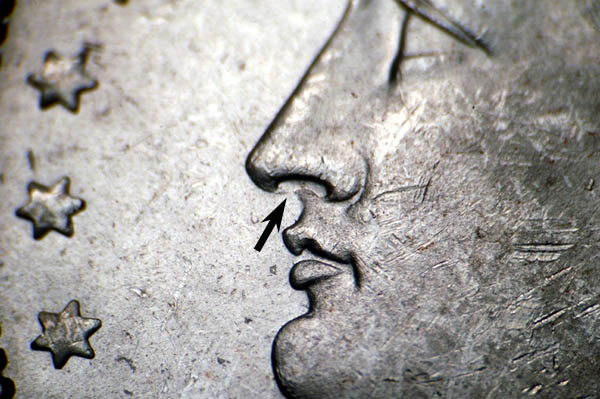
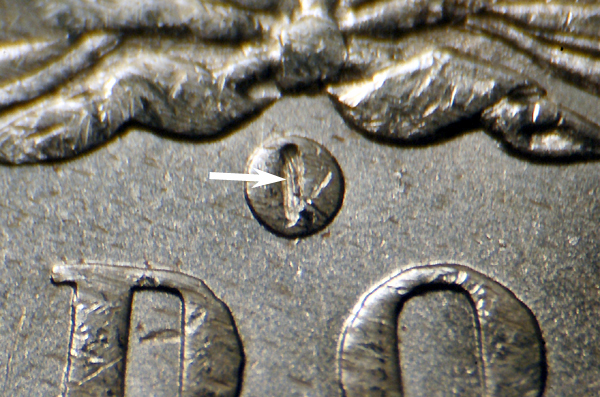
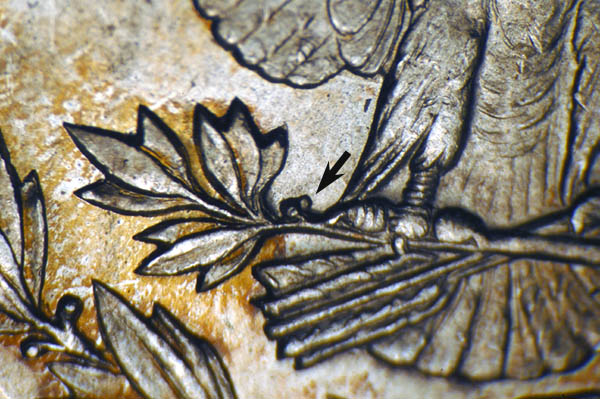
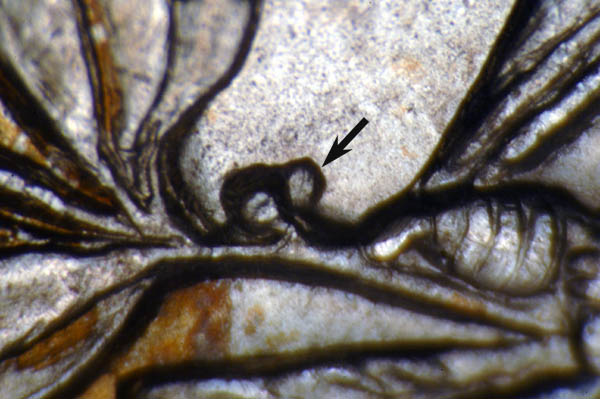
July 12, 2011—One of the first individuals who tutored me in the area of errors and varieties back in the late 1970s was Bill Ewald who is a past member both NECA and CONE (who most of you know later combined to form CONECA). While Bill eventually strayed away from specializing in error-variety coins to numismatics in general, the error-variety bug never left him completely. As such I always have to stop by his table at local shows to see what he may have found. A few months ago, he handed me a batch of Morgan dollars and said, pull out all the VAM varieties and take them with you and shoot what you’d like. Yep, Bill couldn’t help himself and just had to look through a batch of Morgans and catalog all the VAM dollars! While none of the ones I show here are Top 100 VAMs (though he did have one in the group) I found them interesting nonetheless so I thought I’d share a few of the coins I shot with readers. They are shown here with their descriptions.
1878 7 TF VAM-132 “Broken Nose” Abraded Die Variety
1883-O VAM-5 Repunched Mintmark O/O West (Listed in the Wexler/Miller RPM Book as RPM#5 and is presumably listed as such in the CONECA files)
1902-O VAM-79 Near Date/Extra Berry—One of many known for this date/Mint
A closer look at the 1902-O VAM-79 Near Date/Extra Berry
This thin thread-like raised area next to the cotton leaf (on obverse) is a marker for the 1902-O VAM-79 To learn more about this variety go VAM World here.
October 09, 2011—The 52nd Suburban Detroit Coin Show held in Livonia, Michigan September 29-30-Oct 1 has come and gone. As was the case at the last show, the Combined Organizations of Numismatic Error Collectors of America was offered a table for me to act as the “answer man” on error-variety coins and to shoot images for my articles.
Two coins that I felt were very interesting and of a timely nature were a 2011-P Rutherford B. Hayes Presidential dollar and a 2011-P ATB Olympic quarter both of which boast strong Clashed Dies. Both coins also represent the latest and last designs to be released for this year for their respective series.
The Rutherford dollar displays spectacularly strong clash marks on both the obverse and reverse. This is one of those coins where there is no reason for me to add arrows to the images to point out the anomalies – they just reach out and grab you on both the obverse and reverse.
I’d like to thanks Chuck Sharp, the promoter of the show for giving CONECA four tables this year, not only for my work but so that CONECA members, Mike Howard and James Motley could exhibit several cases of error coins along with giving seven PowerPoint presentations spanning two days on an introduction to error-variety coins.
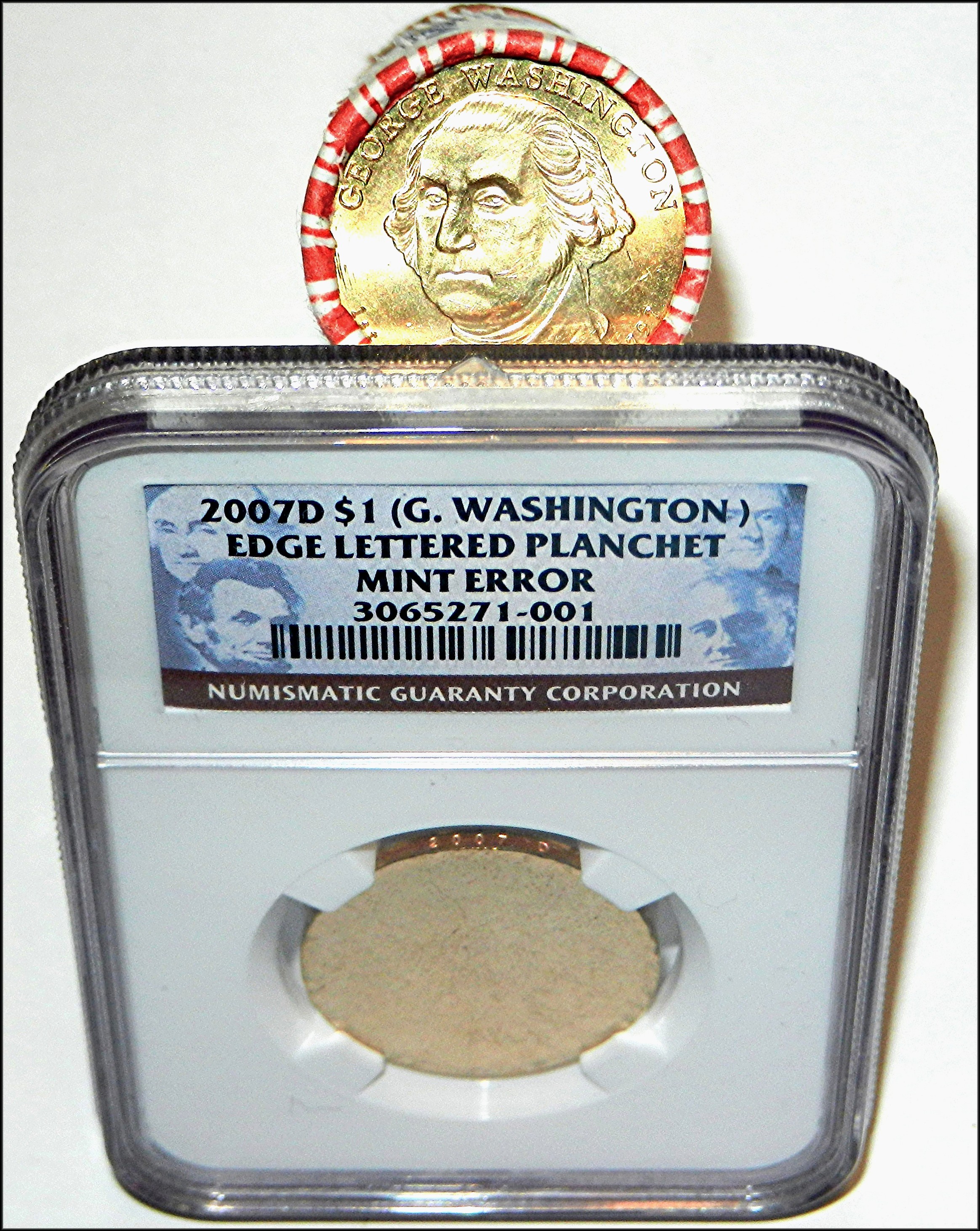
Frank Wolff dropped by the CONECA table at the American Numismatic Association 2014 World’s Fair of Money in Chicago (Rosemont) with this nice 2007-D George Washington Dollar edge lettered planchet.
On August 28, Numismatic Guarantee Corporation of Sarasota, Fla., posted notice on its website that it had graded the first known example of a 1973-S uncirculated Ike dollar struck on a copper-nickel clad planchet. This coin, Struck at the San Francisco Assay Office, in its satiny uncirculated finish, was offered by the United States Mint struck exclusively for collectors in 40% silver. NCG said:
“Coins accidentally struck on planchets intended for other issues are known for quite a number of United States coin types, but they are rarely more spectacular than when occurring with dollar coins. This superb gem Eisenhower Dollar was struck at the San Francisco Mint for inclusion in the series of “blue pack” silver-clad dollars offered by the US Mint at $3 apiece from 1971 to 1974. At first glance it could almost pass for one of these silver-clad pieces, but inspection of its edge (made all the more easy through NGC’s unique EdgeView™ holder) reveals the bright orange-red glow of a copper-nickel-clad planchet! This coin has the satiny texture typical of most silver-clad dollars and confirms that it was struck accidentally as part of that series.
The Denver Mint was assigned the role of preparing planchets for San Francisco’s production of the “blue” Ikes, but it was simultaneously making planchets of the copper-nickel-clad composition for its own press run of circulating coins. One of these ordinary planchets evidently found its way into a shipment of silver-clad planchets going to San Francisco and was struck and packaged as a silver-clad issue. While this scenario describes how such an error could have occurred, it did not play out very often. This is the first report of a 1973 S Dollar struck on a copper-nickel planchet.
If that weren’t enough to excite collectors, this coin is also a doubled-die obverse variety! It is DDO-2, as listed and illustrated in the book CONECA Attribution Guide to Eisenhower Dollar Die Varieties by James Wiles, Ph.D. This variety, previously known only in the normal silver-clad composition, is now confirmed on a copper-nickel-clad planchet intended for currency strikes. Collectors should check their “blue packs” for more new discoveries.”
It should be noted here that San Francisco also struck millions of the copper-nickel clad planchets for proof dollars that were included in the standard six-coin proof sets that contained the cent through dollar. Thus, the mix-up may not have occurred at Denver at all. If a copper-nickel clad planchet (or more) remained in the bottom of a tote bin that was later filled and used to transport 40% silver clad planchets to a press striking the 40% uncirculated silver dollars, the wayward copper-nickel clad planchet(s) would have gotten mixed in and could have easily hitchhiked a ride into a press striking the 40% uncirculated dollars. Exactly were the planchet(s) got mixed up, we’ll probably never know.
In regard to its value, Alan Herbert said, “I’d go for at least $5,000.00. Other transitionals have been selling for $1,500 for years.” Error dealer, Mike Byers of San Clemente, CA said, “I’ve handle many Ike off metals, both in mint state and proof. Also many of the Ike Dollar and Kennedy Half transitionals as well. This may be scarcer than the other halves and dollars struck in silver instead of clad, or clad instead of silver, due to planchets being mixed up. I would estimate a wholesale price of $7,500 and a retail price of $10,000.
As one who has been tracking the values of these transitional type errors over the past few years, my assessment of value is $10,000.00 for this coin. It will be interesting to see were it ends up when it finally comes up for sale. The hobby will be eagerly waiting!
Many collectors refer to these “wrong composition planchet” type errors as “transitional errors” since most occur during a transitional period when a coin’s composition is changed from one alloy to another. For example, a few 1943 cents from all Mints, which are normally struck on zinc coated steel planchets, are known struck on copper alloy planchets left over from 1942. While this Ike dollar is not technically a “transitional”, it is often referred to as such anyway.
Readers should note that both of the errors described here are types of which more could have been made and released to collectors. Identifying them should be easy, simply look for the widely rotated reverse on the Korean dollars and the telltale copper-core on the Ike dollars. Let Numismatic News or me know what you find!
Credit should be extended to NGC and Heritage Auctions for the respective photos shown here.
Ken Potter is the official attributer of world doubled dies for the Combined Organizations of Numismatic Error Collectors of America and for the National Collectors Association of Die Doubling. He also privately lists other collectable variety types on both U.S. and world coins in the Variety Coin Register. He is a regular columnist in Numismatic News’ sister publication, World Coin News, were he pens the Visiting Varieties column.
This is an example of one of the earlier reported mules that was handled by Fred Weinberg
July 29, 2011—An 11th example of the undated double-denominated Sacagawea dollar/Washington quarter dollar mule error coin has surfaced, 11 years after the first example was found in Arkansas in 2000.