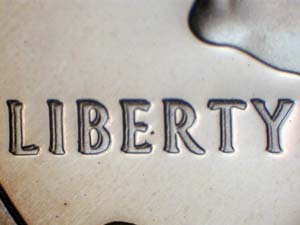
Coin World’s Managing Editor, William T. Gibbs, reports that the discovery of a 1971-D Kennedy half dollar struck on a silver-copper clad planchet is evidence that exciting coins like this transitional error can still be found.
August 16, 2015—The first reported (and to date the only known to me) 1952 Proof Franklin half dollar with a “Bugs Bunny” die clash was auctioned off by GreatCollections on Sunday, August 16th for $5,775 including the buyer’s fee. The variety was previously unrecorded until recently when it was reported by Chris Tisdale from Utah.
It was first publicizes in CONECA’s July/August 2015 ErrorScope by Bill Fivaz and can be found reported upon further down on this web site.
The nick name Bugs Bunny comes from the fact that the clash marks within Franklin’s mouth mimic long teeth as those seen on the cartoon character Bug Bunny. They originate from the feathers of the Eagle to the right of the Liberty Bell on the reverse of the coin. Clashes occur when a planchet fails to enter between the dies during a cycle and the dies clash into each other often imparting portions of the design of one or both die(s) to the other die.
This may very well represent a record price paid for a “Bugs Bunny” die clash.
The “Bugs Bunny” variety is known to many on the 1955 Franklin Half Dollar business strike and it is also known on other business strike dates and mint marks. However, it was previously unknown on a Proof issue. It has been graded PCGS Proof-65 as FS-403 Bugs Bunny, with CAC approval.
Cherrypickers’ co-author Bill Fivaz wrote: “The clash marks at the mouth of the eagle’s wing on the reverse are every bit as strong as on the 1955 business strike and because the discovery coin is an early strike from the clashed dies (it’s somewhat frosted on both obverse and reverse) it is naked eye obvious.
“ The coin is destined to be listed in the 6th Edition, Volume 2 of the Cherrypickers’ Guide by Bill Fivaz and J.T. Stanton and it has appeared in Coin World and Numismatic News articles when the coin was first discovered earlier this year.
If you are an owner of one (or more) of the estimated tens of thousands of unopened 2002-S Silver Proof Sets you may be in for a pleasant surprise! Numismatic News has just reported upon a set that contains a Kennedy half dollar with a very prominent “Spiked Head” die crack that error coin dealers around the country estimate will at least double or even possibly quadruple the value of the set!
The set was found by Springfield, Mass., collector Karl Krokenberger who purchased it unopened from the Springfield based Coin And Card Exchange in late October of 2002 and later discovered that the Kennedy half contained a very prominent die crack that ran from just above the center of Kennedy’s portrait up to the rim at about 12 O’clock.
Error dealer’s Fred Weinberg of Weinberg of Encino, California; Rich Schemmer of Franklin Square, New York, and Chuck Avery of Grand Rapids, Michigan, estimated its value (as a single coin) as ranging from $100.00 to $300.00.
July 12, 2011—CONECA Member, Bill Fivaz of Cherrypickers’ Guide fame sent in this photograph of a nice tripled die reverse that is one of a number of new listings slated for inclusion in Cherrypickers’ Guide To Rare Die Varieties Fifth Edition Vol. 2 by Bill Fivaz and JT Stanton. It is listed by CONECA as DDR-002 – 2-R-II (3). Originally reported to CONECA by Ed Raser, the variety boasts strong doubling to tripling on the Eagle’s left wing feathers (viewer’s right), tail feathers and a slight to moderate spread on HALF DOLLAR and AMERICA, with tripling on the F of HALF and last A of AMERICA. Other doubling can be seen on the eagle’s claws, the perch upon which the eagle rests, etc.
Pepe DeMeo of New York sent in a 2001-P Kennedy half-dollar with some very interesting effects. While a normal coin has basined fields so that the central design can be raised up from the recess with some degree of relief and still be lower than the rims in order to facilitate protecting the designs for better wearing qualities and stackability, the reverse of his coin is convex somewhat like a brass button. The area where it slopes down toward the rim the fastest begins at the circle of stars—though the field seems to actually begin its decent towards the rim much closer to center. Many of the stars that encircle the central design are connected by die-stress-cracks. As a result of the convexity, the coin will not lie flat on the reverse rim but instead teeters on the uneven highpoints of the design upon which it could actually be spun like a top. For all practical purposes, the obverse is normal. DeMeo was able to find seven of them out of ten $100 face value bags that he purchased from the United States Mint website in around July of 2008. He found four in one bag and one each in three other bags.
In the 30 years that I’ve been specializing in error and variety coins, this is the very first example I have seen of a coin with either the obverse or reverse bearing any kind of convexity of this sort!
So, other than the obvious fact that the die was breaking up, what does this coin represent? I sent my questions to Sean Moffett of Moffatt & Company a private mint located in Eureka Springs, Arkansas, and got the following answer:
“The die was on the verge of a massive cud break or total failure. For this convex shape to happen the reverse die would have to be in the collar side of the press. The outside edge of the die had already began to break away and the pieces were probably wedged between the collar and the die, and were not re-seating completely in their original position during coining which would make them higher than the field which would make the edges of the coin seem to fall away which is why the coin appears to be convex. I have had this happen and either the collar will break allowing the pieces to fall out or the die would finally “explode” and all the pieces would fall out. Both have happened to me. It sounds like a 45 going off when a collar lets loose due to a cud break. The US mint should of have been using a carbide insert collar by 2001, and when the carbide broke it would of shattered into pieces instead of cracking or breaking in to 2 or 3 pieces like a standard collar. The carbide could of have withstood the wedging of the die pieces longer than a standard collar before breaking, which could account how this piece came into existence.”
Moffatt was Operations Manager for a large private mint (Hoffman Mint) for 19 years where he oversaw the production of over 65 million units per year, until the company was sold and relocated. He has attended several Mint Directors Conferences and numerous industry events, and he is thoroughly networked in the minting trade. His educational background includes four years of electronics. He can design, build, and maintain machine and industrial controls. He has experience as an electrician, machinery rigger / transporter, a haz-mat transport driver, cryogenic filling plant technician, and an electronics technician. He is proficient with AutoCAD for tooling design, facility design, and plant layouts. He has the mechanical ability to tear coining presses and support equipment down to the frame and rebuild or repair most all problems in house. Moffatt is an experienced machinist and builds many of the tooling parts he designs. He is now President of Moffatt & Co., located in Eureka Springs, AR. The company was founded in October 2007 with former Gallery Mint chief coiner Timohy Grat. Moffatt & Co. specializes in high speed production of coins & tokens, as well as high end medals in base & precious medals. He is in the process of writing a book exploring the mechanical causations of the different types of minting errors.
In this photo (and the one above) you can see by the lighting technique used, that the field begins to dip sharply about midway into the outer ring of stars. This line of demarcation is aptly defined by the partial circle of die cracks that connect most of the stars.
Die cracks run through the circle of stars, up through the left leg of the last A of AMERICA and through the stars and clouds above EPU.
The die crack running through the L of HALF becomes a bi-level crack when it enters the rim.
Die cracks are present at the end of the arrows and stem of olive branch.
In this view the die cracks through the F of OF and DO and second L of DOLLAR are shown to best advantage. The distortion of the sinking die is obviously taking it toll on the die steel.
Another view of the above area shot with different lighting.
Proof Coin Reveals One Style of Mintmark Punched over Another
SARASOTA, FLA. (March 22, 2017)—Numismatic Guaranty Corporation® (NGC®) has certified a newly discovered variety for the popular Kennedy Half Dollar series. Submitted for attribution under NGC’s VarietyPlus Service by Florida dealer Bob Ryan, it was at first suspected to be a normal “S” mintmark punched over an inverted impression of the same letter, but the 1968-S Proof Half turned out to be so much more.
Enlarged photographs of the mintmark area revealed two oddities. The first was that the mintmark is of a style not seen on other 1968-S Half Dollars nor, for that matter, on other San Francisco Mint coins of the period. In fact, NGC Research Director David W. Lange was not able to place it on any other coin. Thinking that it may have been used on a foreign coin struck by the San Francisco Mint, Lange showed the coin to colleague David J. Camire, an NGC Finalizer and error coin specialist. Camire consulted an extensive database of world coins made by the US Mint, but was also unable to find a match for the mintmark style..
The second peculiar feature of the mintmark is that a knob projects to the side of each serif, hinting at another, underlying style of mintmark. Lange sent photos of the mystery coin to several experts in the variety/error field for opinions. Bill Fivaz, co-author of The Cherrypickers’ Guide to Rare Die Varieties of United States Coins, suggested that the underlying letter is similar to the Knob-Tail “S” (mintmark) last used on San Francisco Mint coins in the late 1940s. Fivaz also speculated that the primary mintmark was itself inverted, though its nearly symmetrical shape makes this hard to determine with certainty.
Variety/error specialist Ken Potter revealed that he’d seen a box full of different puncheons while taking a 1998 tour of the Philadelphia Mint. These were preserved by the Engraving Department’s Edgar Steever, who’d been at the Mint for decades and was reportedly the main applier of mintmarks before this feature began to be sculpted into the master dies starting in the 1980s. It was thus possible that any number of different mintmark styles remained on hand in 1968. Retired numismatist and respected researcher Tom DeLorey agreed that two different mintmarks had been applied..
NGC has assigned its own VarietyPlus number of VP-003 to this remarkable variety, labeling the Ryan specimen as SERIF S/KNOB S, indicating the application of one mintmark style over another. The coin is a particularly attractive piece and was certified as NGC PF 67«. The NGC Star Designation was included to denote its superior eye appeal as a one-sided cameo coin (the reverse does not possess frosted devices).
Illustrated here are close-ups of the new variety, VP-003, and also an example of the style of mintmark usually seen on the 1968-S Half Dollar. This normal style has a serif at top and a knob end at the bottom.
It’s anticipated that the rush will be on to find additional examples of this fascinating new variety. Such coins may be submitted to NGC for grading and encapsulation at the normal tier rate, with an additional $15 fee for variety attribution. Coins already certified by NGC may have a variety added for the same $15 fee, which includes the cost of reholdering.
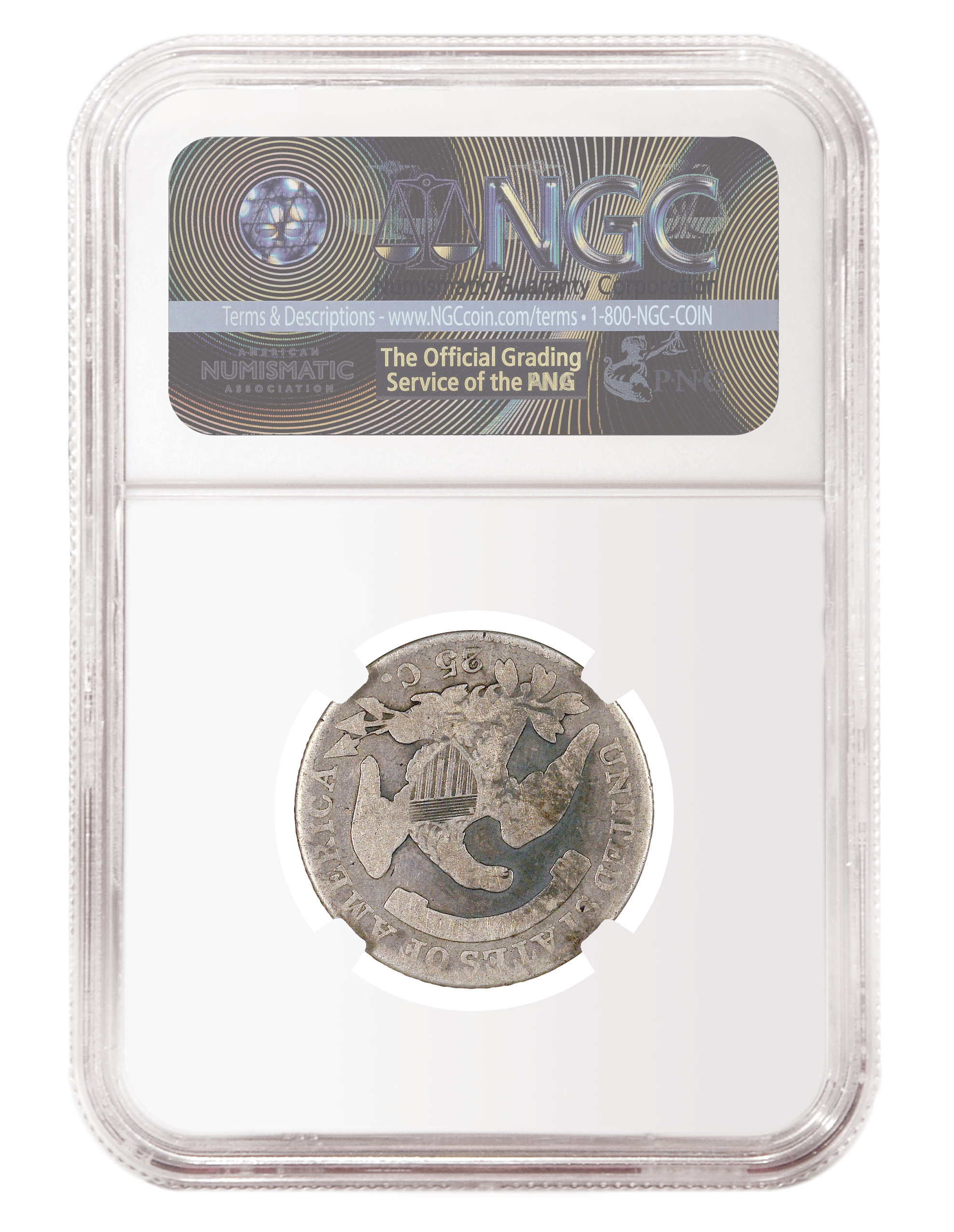
1822 B-3 is a Previously Unknown Die Marriage SARASOTA, FLA. (June 6, 2017)—Numismatic Guaranty Corporation® (NGC®) has certified an 1822 quarter dollar variety that was previously unknown to numismatists. The new discovery has been cataloged as Browning-3, adding a third variety to the two 1822 die marriages that have been sought by generations of quarter collectors.
The numbering system for early quarter dollars was devised by Ard W. Browning and published in his 1925 book, The Early Quarter Dollars of the United States. Though this reference has since been superseded by two superior works produced within the past ten years, early quarters are still attributed by numismatists according to Browning numbers.
Variety B-1 of 1822 combined Obverse 1 and Reverse R (the reverse dies being lettered sequentially from 1815 onward). B-2 employed this same obverse in combination with Reverse S, which it shared with 1828 B-3. The coin recently confirmed by NGC as a new variety combines Obverse 1 for 1822 with Reverse T, a die used to coin the single varieties of 1823 and 1824 quarters, as well as 1825 B-1 and 1828 B-2. This marriage of Obverse 1 and Reverse T was previously unknown for 1822 quarters.
Reverse T is easily identified by its broken upper arrow shaft and lower arrow head. This same die state is seen on the scarce 1823/2 quarters, but the die was subsequently repaired before use with the three later dates. These 1824/2, 1825 and 1828 quarters reveal an engraving scratch from the lower arrow head that attests to its repair.
NGC was selected to certify this presently unique coin after its owner, a collector in Illinois, contacted Heritage Auctions. His photos were sent to Heritage Auctions President Greg Rohan, who shared them with Senior Numismatist Mark Borckardt and Cataloger John Sculley. It was on their advice that the owner met with NGC Research Director David W. Lange at a coin show, where Lange accepted the coin for certification. It was carefully studied for authenticity, grade and variety before being certified by NGC as AG 3, B-3, Discovery Coin.
The subject coin is worn in a pattern that suggests the dies were not perfectly aligned. Its obverse is more worn at the left, while its reverse shows greater wear at the right. The quarter is naturally toned, with lighter relief elements that give it a slight cameo quality, and a subtle planchet lamination is visible at 8 o’clock obverse. The coin’s owner has not announced any plans for his rarity.
NGC will attribute all Browning varieties under its VarietyPlus Service for a fee of $15 above the grading tier fee. Coins already certified by NGC may be submitted to have an eligible variety attributed at this same $15 fee, which includes the cost of reholdering. Learn more about VarietyPlus at NGCcoin.com/VarietyPlus
About Numismatic Guaranty Corporation® (NGC®) NGC, the world’s largest and most respected third-party coin grading service, was founded in 1987. From the beginning, NGC has committed itself to developing an impartial, trusted standard of consistent and accurate grading. To uphold this commitment, NGC’s full-time grading professionals are no longer active in the commercial coin marketplace, and are prohibited from buying or selling coins to ensure impartiality. As NGC has grown to become the leader in third-party grading services, we have maintained a steadfast and uncompromising commitment to this standard. Learn more at NGCcoin.com.
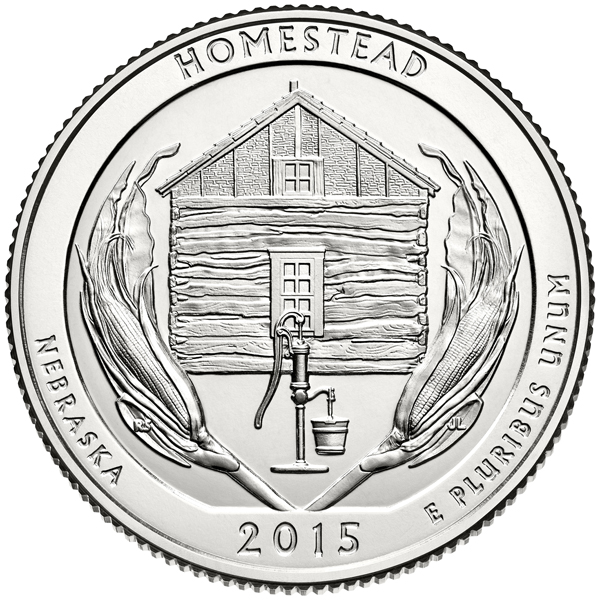
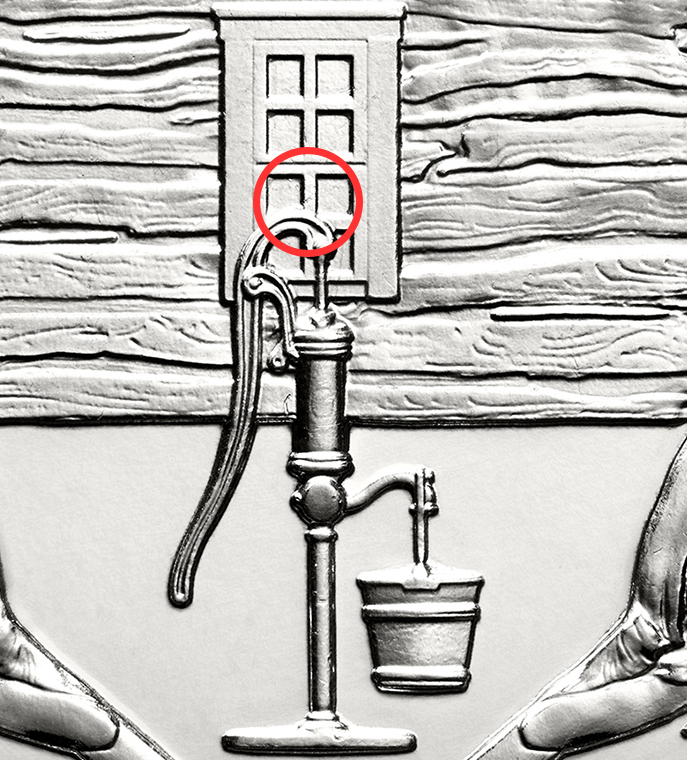
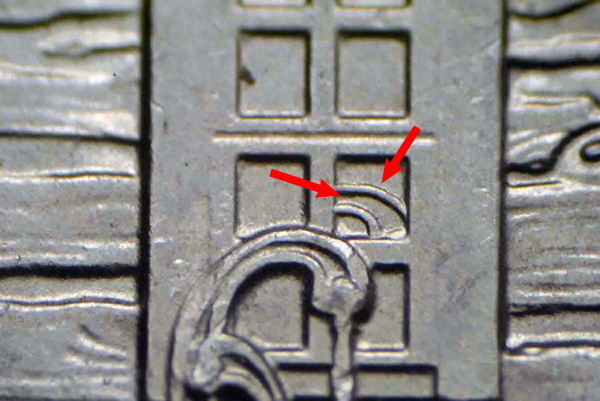
Steve Atwood of Florida managed to nab five new doubled-die reverse varieties of the recently released 2015-P Homestead (Nebraska) America the Beautiful quarters. At least one of the varieties falls into the category of what I’d consider major while a second variety is what I’d classify as borderline-major, perhaps strong enough to find its way into the Cherrypickers’ Guide To Rare Die Varieties by Bill Fivaz and J.T. Stanton.
CONECA Members Share…
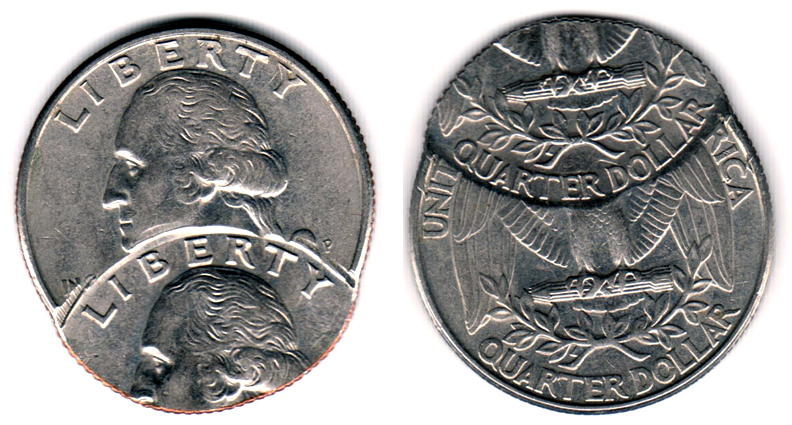
CONECA member Robert Risi shared this Double struck die struck both sides with second strike being about 40% off center. Robert has been collecting coins for 31 years and has focused on error coins the past 17 or so years. This coin was picked off e-Bay raw back in 2013. It is now slabbed in an NGC Holder and graded AU58.
A recent attribution package from ANACS revealed a 1999-S PA States Quarter with the strongest spread DDO of any States Quarter known. The doubling is a class IV, offset toward the East with a tilt, resulting the strong spread on the Left side of the Obverse fading out by the time it reaches the middle of the design. It is on a clad proof planchet.



 In this photo (and the one above) you can see by the lighting technique used, that the field begins to dip sharply about midway into the outer ring of stars. This line of demarcation is aptly defined by the partial circle of die cracks that connect most of the stars.


 Die cracks are present at the end of the arrows and stem of olive branch.


 Illustrated here are close-ups of the new variety, VP-003, and also an example of the style of mintmark usually seen on the 1968-S Half Dollar. This normal style has a serif at top and a knob end at the bottom.
 SARASOTA, FLA. (June 6, 2017)—Numismatic Guaranty Corporation® (NGC®) has certified an 1822 quarter dollar variety that was previously unknown to numismatists. The new discovery has been cataloged as Browning-3, adding a third variety to the two 1822 die marriages that have been sought by generations of quarter collectors.